Spring 2026 / Features

The Balkans and Beyond: A Journey of History, Adventure, and Great Food

by Cheryl Bauman Bock ’79

In fall 2025, I joined 18 fellow travelers for The Balkans and Beyond, a Wilson College tour that felt as much like a reunion as an adventure. Our group represented Wilson classes from the late 1950s through the 1970s, plus their family members, along with President Wes Fugate and Cody Ward. Ward, an international education professional who has visited nearly 60 countries, helped design the itinerary centered on his favorite country, Croatia.
First Impressions

My sister, Donna Bauman Hensinger, was my travel companion. After meeting in Frankfurt, we arrived in Ljubljana, Slovenia, and began exploring the city around our hotel, the Grand Hotel Union Eurostars. We wandered to Prešeren Square, browsed the outdoor farmers’ market preparing for All Souls’ Day, and admired the charming Old Town along the river. The city’s architecture blended Art Nouveau, Gothic, and Baroque elements, most notably the Triple Bridge and buildings designed by Jože Plečnik. Outdoor cafés, artisan shops, and local specialties like handmade lace, Rogaška crystal, and the traditional Slovenian walnut and honey rolled pastry called potica, helped create some of our first impressions of the area.
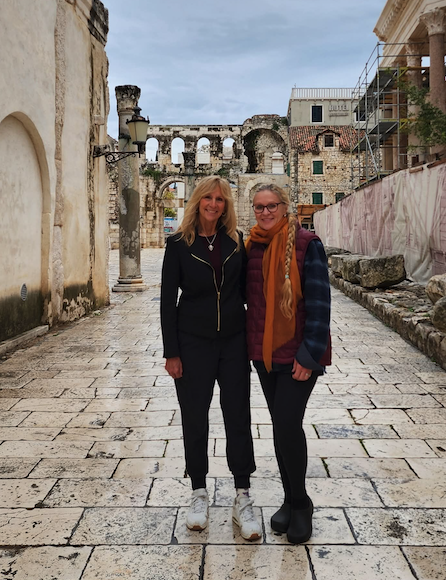
Cheryl Bauman Bock ’79 traveled through the Balkans with her sister, Donna Bauman Hensinger.

The next day, we toured the Franciscan Church of the Annunciation and St. Nicholas Cathedral, both with their breathtaking Baroque-style paintings, altars, and domes. That evening, once everyone had arrived, we enjoyed
traditional Slovenian cuisine with our guide Ian. I tried the delicious house specialty sampler of deer medallions with cherry sauce, stag steak with porcini mushroom sauce, and wild boar with green pepper sauce, plus homemade cheese rolls and potato and bread dumplings. We quickly realized that meals would become anchors of each day, revealing the character of each place we visited.

A morning walking tour took us past Park Zvezda, the Dragon and Butcher’s bridges, and up to Ljubljana Castle via funicular. From the castle viewing tower, we enjoyed panoramic vistas of the city and the Kamnik-Savinja and Julian Alps.

History at the Borderlines

One of the defining pleasures of the trip was the sense that history could be touched, climbed, or walked through. On Wednesday, a day trip to Bled, Slovenia, brought us to its glacial green lake and Bled Castle, the country’s oldest castle, perched on a 130-meter cliff with mesmerizing views of Lake Bled and the Julian Alps. Inside, my sister and I were drawn to the printing press and purchased custom souvenir prints before exploring the courtyard, buildings, and exhibits, and indulging in the famous Bled cream cake with its delicate layers of puff pastry, decadent egg cream custard, and whipped cream.

A border crossing on Thursday took us to Trieste, Italy, a city shaped by Slavic, Italian, and Austro-Hungarian influences. Despite some rain and chilly weather, we enjoyed views of the Adriatic Sea, glimpsed Roman and Baroque landmarks, sampled original Sacher-Torte, and warmed up with pumpkin soup by a fire before continuing to Opatija, Croatia.

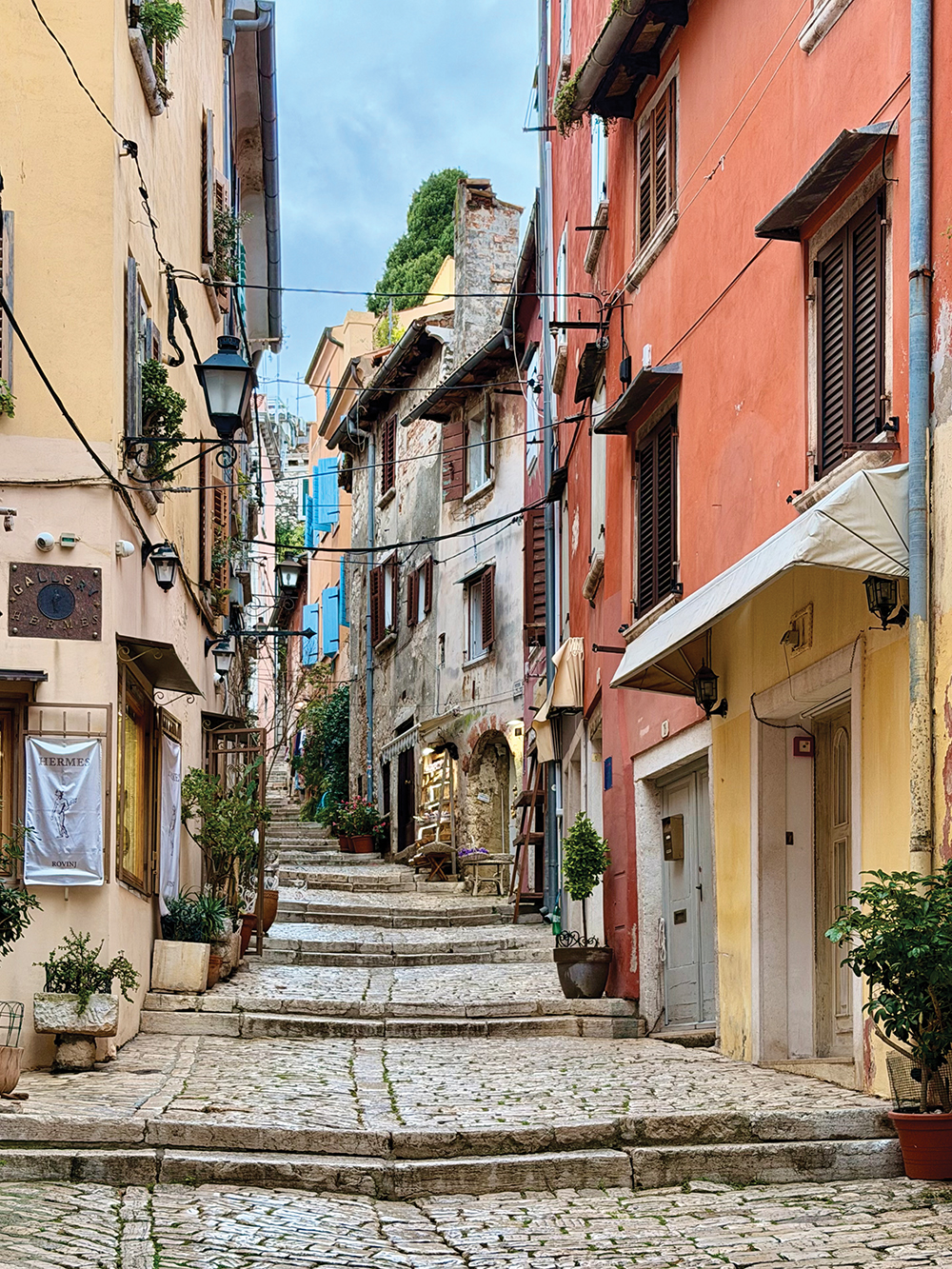
Our tour of the Istrian Peninsula included the historic towns of Pore and Rovinj. In Pore , the sixth century Euphrasian Basilica and its shimmering Byzantine mosaics impressed us, while Rovinj charmed with its coastal scenery and winding cobblestone streets. After a gelato break, my sister and I climbed the winding, hilly cobblestone streets leading to the Church of St. Euphemia, built in the 1700s. Getting lost in the labyrinth of streets on the way down turned into an unexpected treat as we sampled truffles, wine, and olive oil along the way. Rejoining our group, we ended the day in Pula, where a magical sunset illuminated the ancient Roman amphitheater.
Unexpected Joys

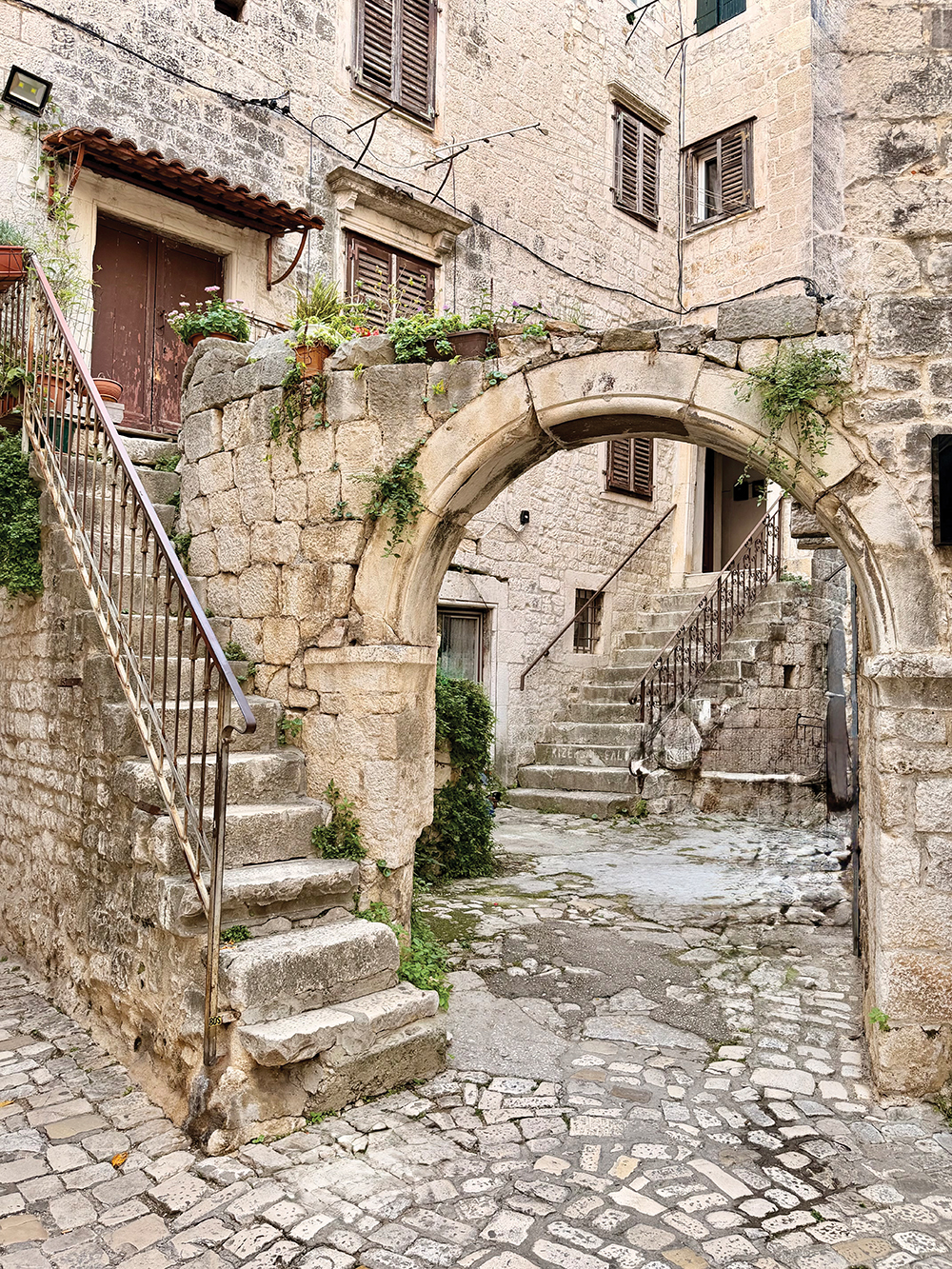
Some of the most memorable parts of the journey came from surprises—the moments that weren’t planned but quickly became highlights. When Plitvice Lakes National Park reached capacity early on Saturday, we had to skip our visit, but the unexpected break gave us time to relax at our next hotel in Split, Croatia. The next morning, we visited Krka National Park, walking along rushing streams and past seven green-tinted waterfalls. Later, our skilled bus driver, Dragan, took us to Trogir, a beautifully preserved medieval town on a small island filled with Gothic, Renaissance, and Romanesque architecture, including Kamerlengo Castle, the Church of St. Sebastian with the clock tower, and Trogir Cathedral.

Pouring rain surprised us the following morning, but despite leaking raincoats and wet shoes, an excellent local guide gave us a tour of the Palace of Diocletian, built for the emperor’s retirement in A.D. 295-305. After the skies cleared, my sister and I retraced the route for photos and ended the day with an amazing meal of bread, prosciutto, cheese, anchovies, fish pâté, and wine.

Along the Adriatic

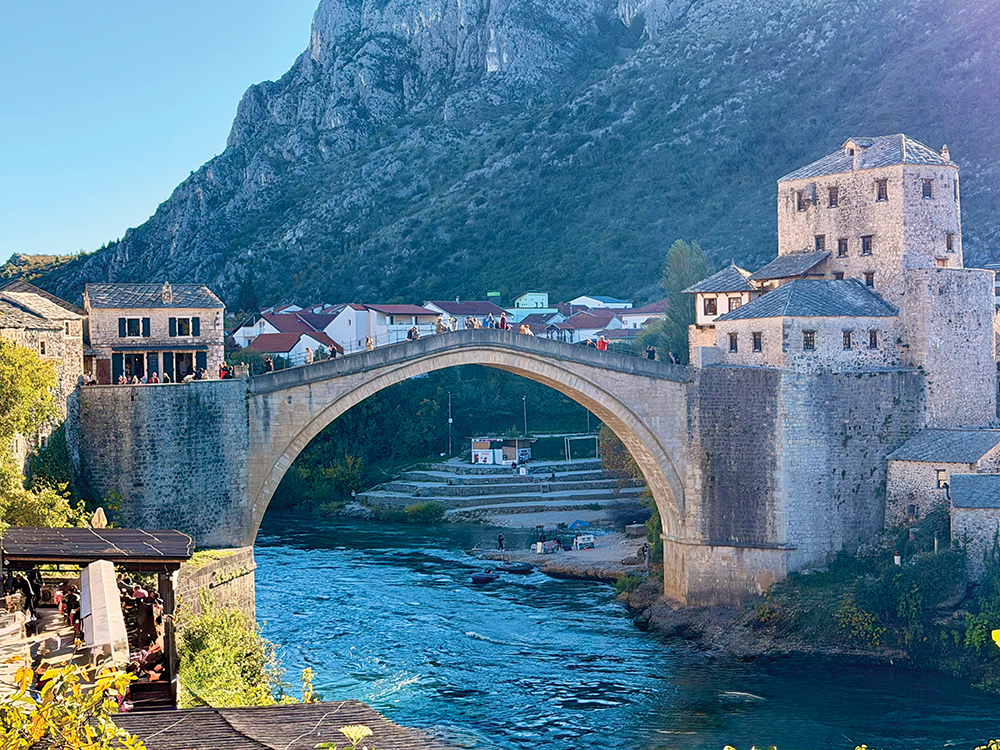
On Tuesday, Nov. 4, we drove along the Dalmatian coast to Dubrovnik, Croatia, detouring into Bosnia-Herzegovina to visit the intriguing city of Mostar with its slippery cobblestone streets, Ottoman-era architecture, markets, mosques, and the graceful arched bridge of Stari Most that soars 20 meters above the Neretva River. That evening, we arrived at our hotel in Dubrovnik for a fantastic group dinner.

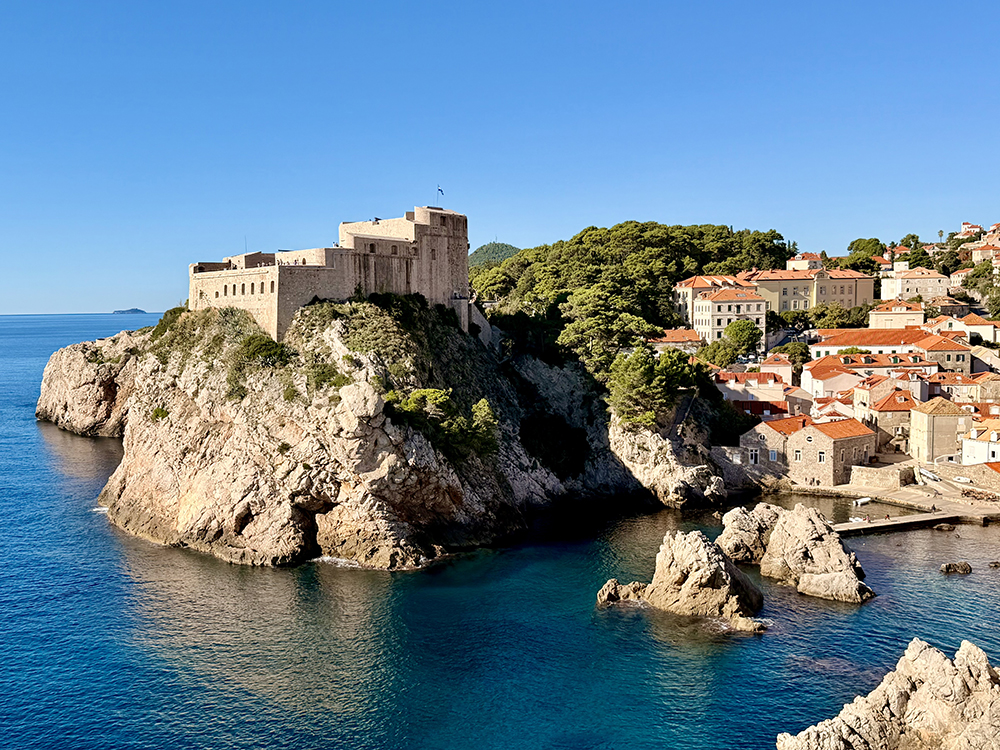
The next day, a walking tour highlighted Dubrovnik’s medieval walls and fortress. Some in our group climbed the ramparts, while others shopped. In the afternoon, many enjoyed a harbor boat ride, while my sister and I relaxed at a bar perched on rocky outcroppings outside the walls, soaking in the sun and technobeat music, while watching kayakers gliding across sapphire water. We even found a few “Game of Thrones” filming sites before returning to discover an early birthday cake from the hotel, which I happily shared with fellow travelers.

On Thursday, Dragan drove us to the charming town of Perast, Montenegro, where we enjoyed a short boat ride to an island church surrounded by stunning views of the Adriatic and the Gulf of Kotor. We continued to the walled city of Kotor—reportedly home to more cats than people—where we sampled local food and shopped before heading to Podgorica. That evening’s farewell dinner came with another birthday surprise: a cake and a group card secretly organized by my sister.
While many travelers headed to Austria the next day, my sister and I chose to explore Podgorica. We strolled along the riverfront, walked to Millennium Bridge, explored nearby Roman ruins, wandered through Old Town, and admired the Orthodox Temple of Christ’s Resurrection. That evening, we enjoyed our final meal of grilled vegetables, rice, sausages, chicken, and pita bread. The next morning, Nov. 8, we flew to Vienna to begin our journey home.
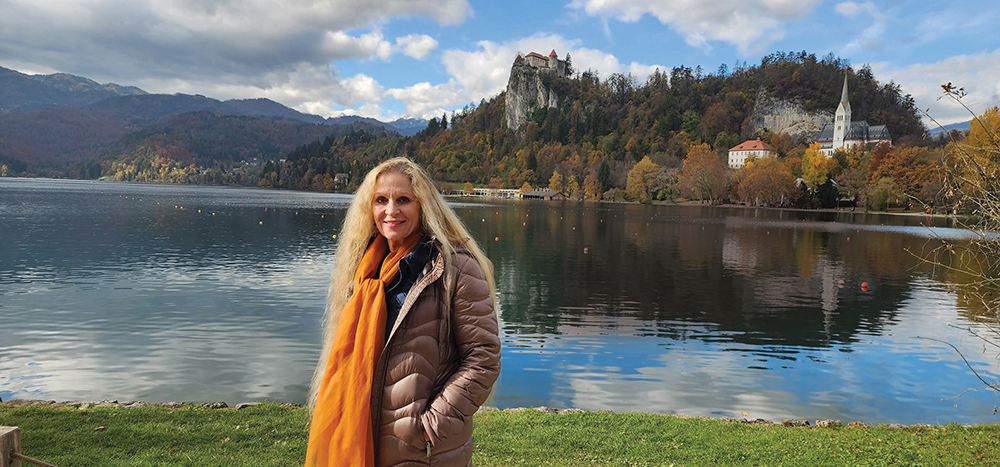
Cheryl Bauman Bock’79 currently serves as a director on the AAWC Board. She is chair of the Heritage Committee and a member of the Connections Committee and its Tours and Travel Subcommittee

Our trip was rich in history, adventures, and remarkable meals that reflected the character of each place we visited. Every town—whether Slovenian, Italian, Croatian, Bosnian, or Montenegrin—offered its own personality, shaped by the layered influences of the empires that once ruled there. The Balkans gave us much to admire, but sharing these discoveries with fellow Wilson alumnae made the experience truly unforgettable. We left with deeper friendships and an eagerness for future adventures together.
 

RELATED: Students Between the Tides When Herbert Hoover Visited Wilson College Wilson’s Strategic Partnership Fuels Innovation

Students Between the Tides

By Sherri Buerdsell, Ph.D., Assistant Professor of Biology

One core component of Wilson College’s Marine Biology course is a three-day field trip to the Chincoteague Bay Field Station in Wallops Island, Virginia. This year, the experience marked a first as alumna Katie Riley ’24, who majored in environmental science, led the class as field educator. She is now the assistant program coordinator at the Chincoteague Bay Field Station.

“The experience made classroom concepts feel more real, especially while learning about coastal ecosystems and wildlife in such a unique environment.” — Emily Breighner ’27

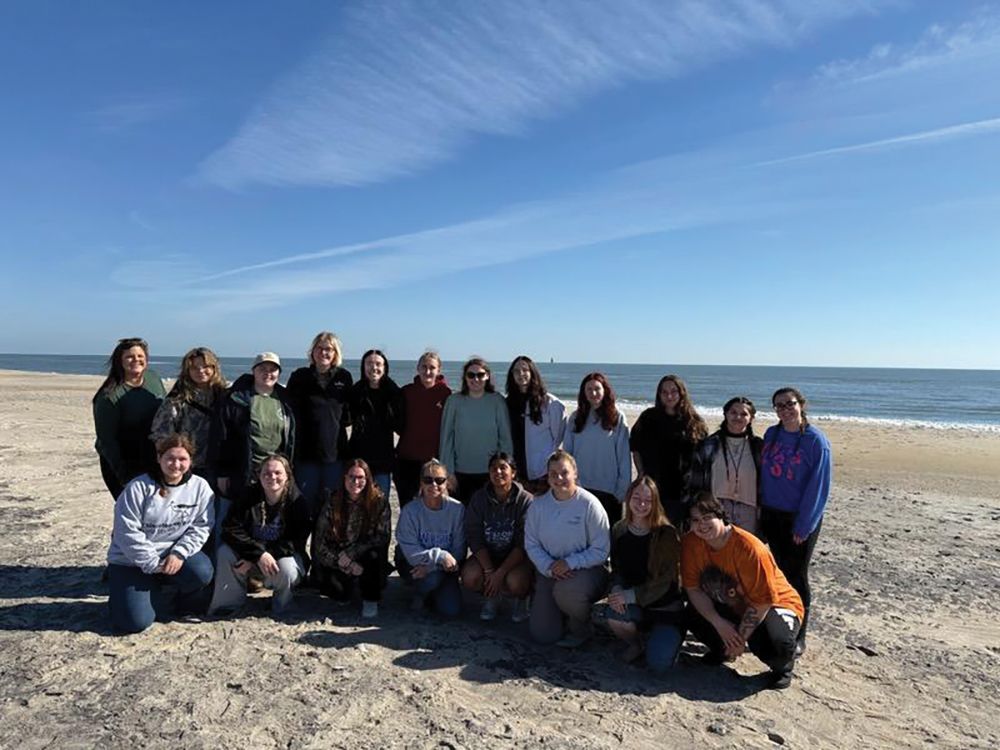
Back (l to r): Stephanie Summers, adjunct instructor of biology, Olivia Dingzon ’27, Morgan Browning ’26,
Emily Johnson ’26, Emily Breighner ’27, Kalea Pechart ’26, Sarah Bushey ’26, Raven Williams ’28, Amanda Blount ’26, Madison Kellogg ’27, Katelyn Dehaven ’26, and Sophia Sensabaugh ’27.

Front (l to r): Hayden Sturgeon ’26, Kaelyn Goff ’27, Caitlin Oliviero ’27, Sherri Buerdsell, Ph.D., assistant
professor of biology, Jade Syto ’27, Katie Riley ’24, assistant program coordinator at the Chincoteague Bay
Field Station, Katy Hedderick ’27, and Kris Robinson ’26.

“My time at the Chincoteague Bay Field Station has been an invaluable opportunity to study marine ecosystems and the organisms in them, as well as to communicate and teach this information to visiting students,” said Riley. “This experience has allowed me to apply the knowledge and skills I developed during my college coursework, drawing directly from the classes and instruction I received from my professors at Wilson. Through hands-on fieldwork in a variety of settings, I have been well prepared for the responsibilities of my current position.”

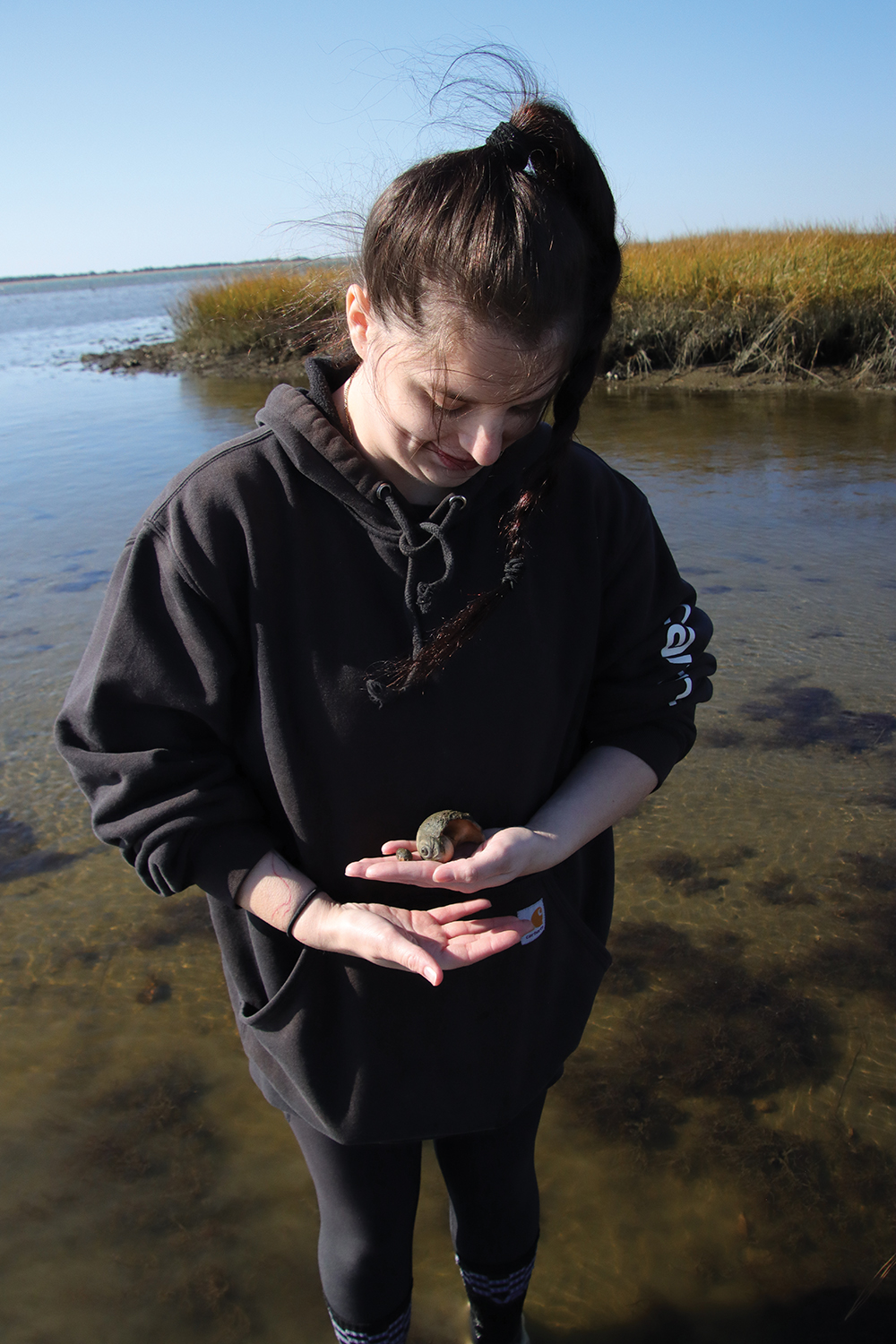
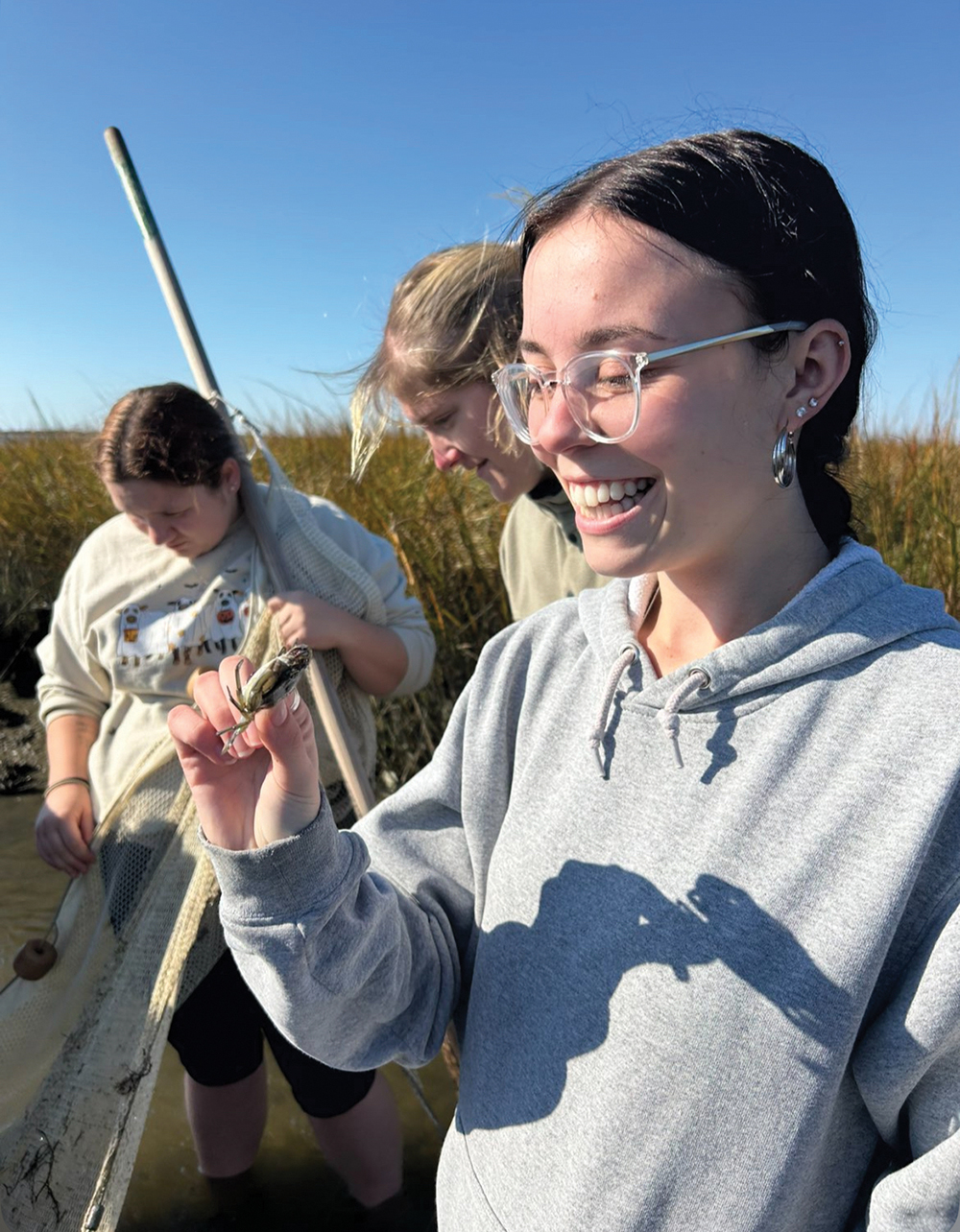
Katelyn Dehaven ’26 enjoyed comparing hermit crabs, one big and one adorably small.

In the middle of the Fall 2025 semester, while other Wilson students were attending Halloween parties back on
campus, 16 students in this year’s Marine Biology class participated in the required field experience Oct. 31–Nov. 2, 2025. Adjunct Instructor Stephanie Summers served as an additional source of marine biology expertise and as a driver.

“It was a such a cool experience to learn about all the life on the different parts of the intertidal zones.” — Sophia Sensabaugh ’27

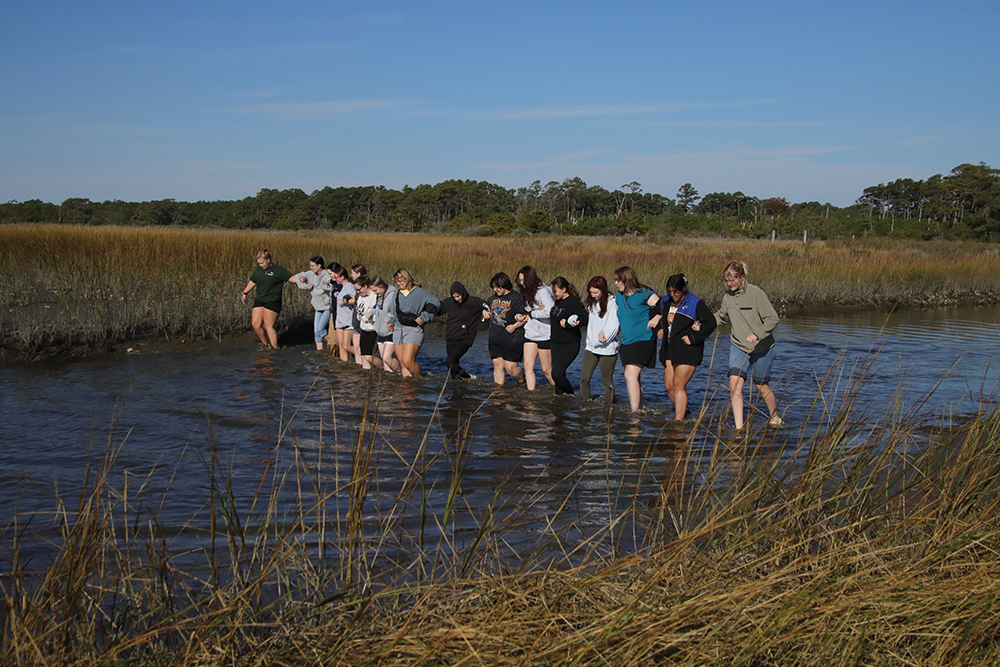
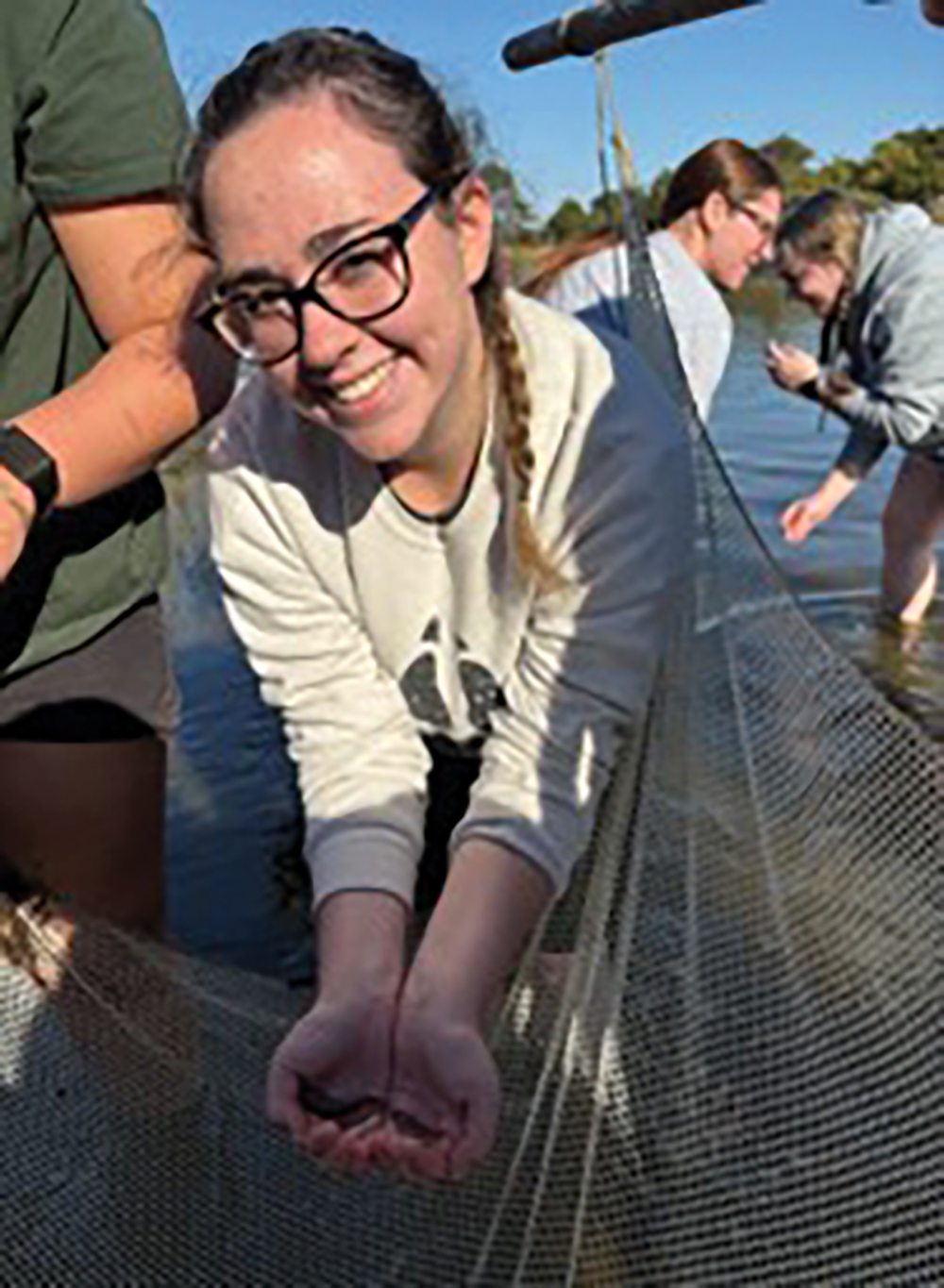
During the intertidal studies, the students walked in a line to herd fish and invertebratesinto a seine net to sample biodiversity.

During the trip, students explored the ecology of Chincoteague Bay, focusing on the intertidal zone and barrier island ecosystems. The class studied animals and plants that live in the area between high and low tides, using multiple techniques to collect organisms for identification.

On the Ocean Research Cruise, students experienced trawling and caught a variety of marine organisms, including a terrapin and seahorses. On Assateague Island beach, students built different types of dunes to understand how barrier islands protect the mainland from storms. Despite the fall temperatures, several students even swam in the ocean.

Marine Biology is offered in the fall of odd numbered years and is open to all students who have taken General Biology I and II.

“Seeing the Chincoteague Bay Field Station made me want to work at a place like it.” — Katy Hedderick ’27


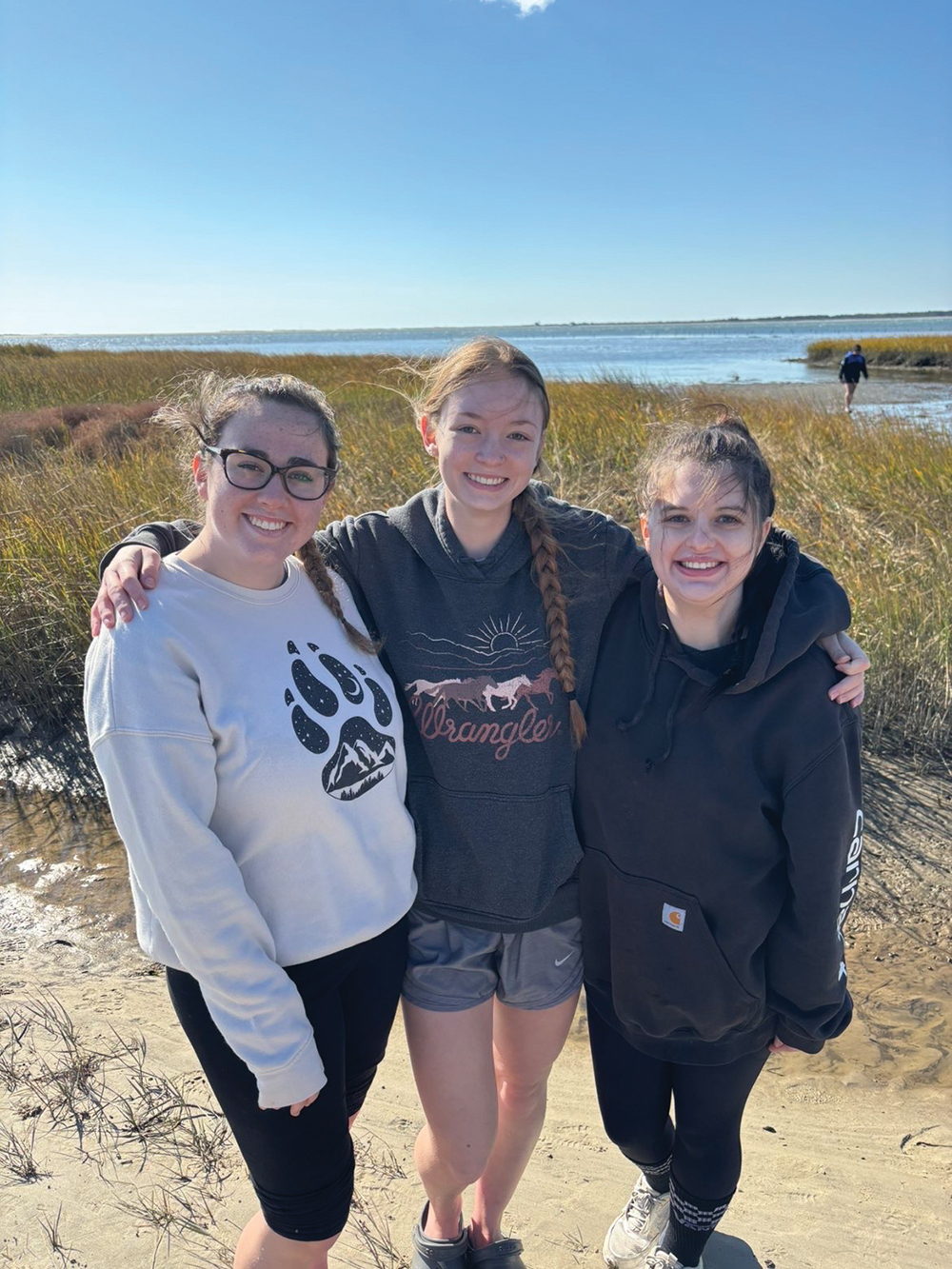
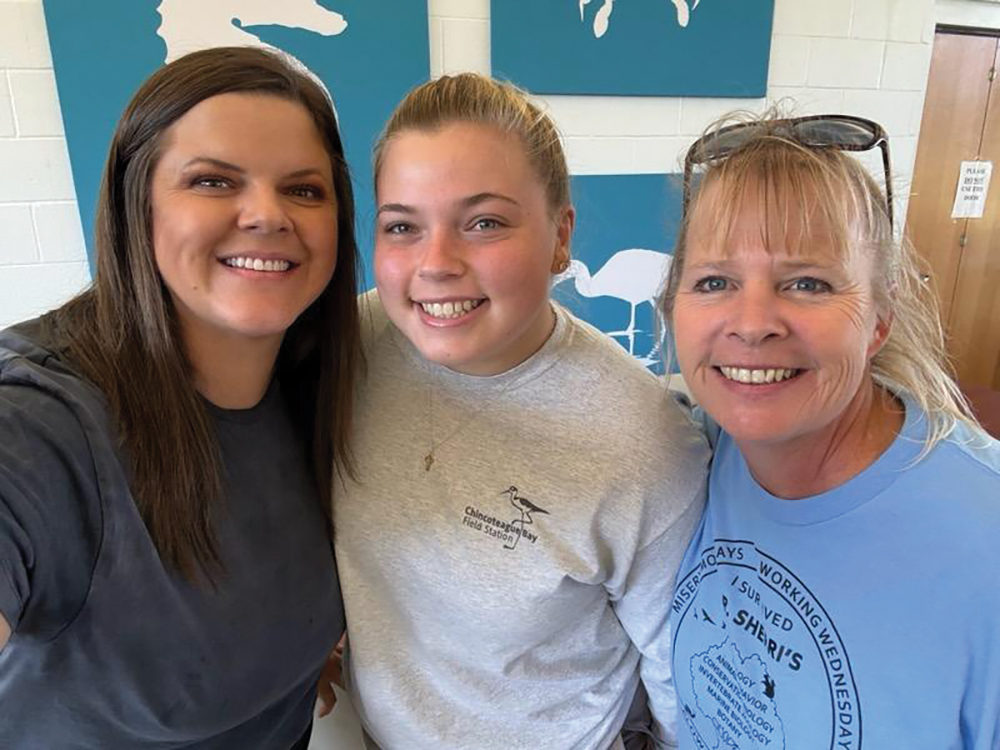
Left to right: Stephanie Summers, adjunct instructor of biology, Katie Riley ’24, assistant program coordinator at the Chincoteague Bay Field Station, and Sherri Buerdsell, Ph.D., assistant professor of biology.

RELATED: The Balkans and Beyond: A Journey of History, Adventure, and Great Food When Herbert Hoover Visited Wilson College Wilson’s Strategic Partnership Fuels Innovation

When Herbert Hoover Visited Wilson College

By Maxine Wagenhoffer, Ph.D., Director of the Hankey Center for the History of Women’s Education and Assistant Professor of History

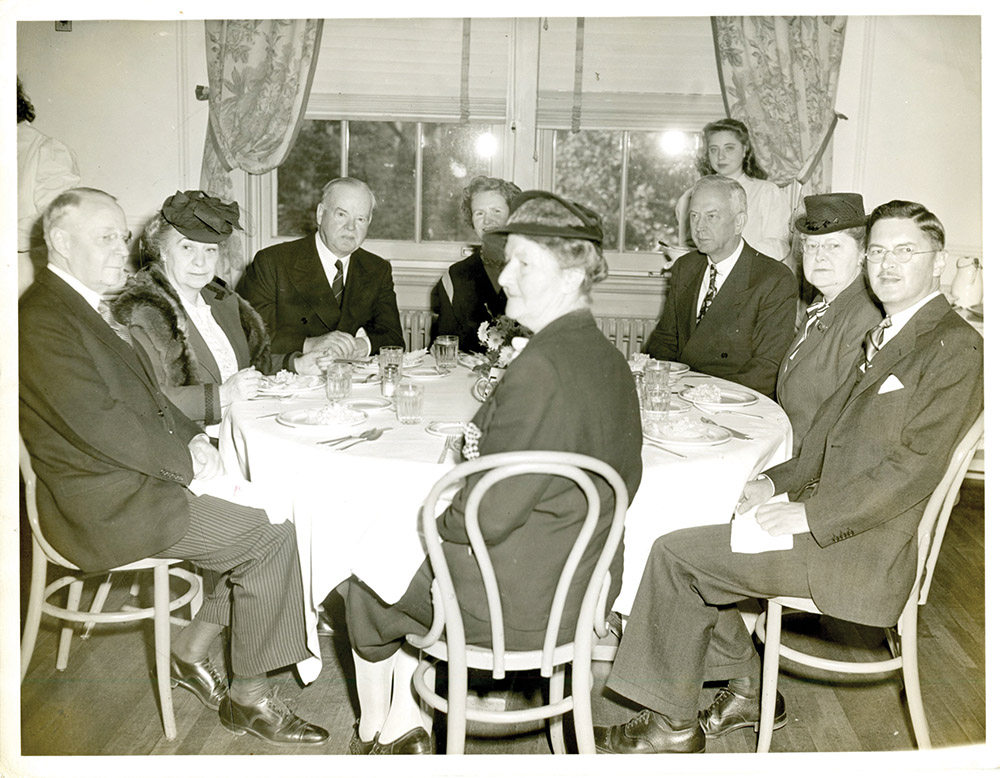
In October 1945, Wilson College held its 75th anniversary celebration. The three-day event included a convocation on Saturday featuring a well-known guest: Herbert Hoover. Herbert Hoover served as the 31st president of the United States from 1929 to 1933; his post-presidential career was noted for his food relief efforts during World War II. Hoover’s visit occurred not too long after World War II’s formal conclusion.

How did Wilson College land such an illuminating guest? It was not a simple path. Paul Swain Havens, who served as Wilson College president from 1936 to 1970, reached out to the former U.S. president during the summer of 1945. Havens explained that the weekend’s theme for the anniversary was “citizenship with such discussion of women as citizens as is appropriate at a woman’s college.” Havens stressed that the institution had “always been alert to the responsibilities of citizenship.” Havens wished for Hoover to focus “on the responsibilities of college trained men and women in the present and in the future.”(1) At first, Hoover expressed that he was “not making any commitments of that kind.”(2) However, on Aug. 1, Hoover wrote to Havens that he would participate in the celebration.(3) Meanwhile, journalist Eve Garrette, an alumna from the class of 1918 who was known for her book entitled A Political Handbook for Women, was close with Hoover. Garrette received a letter from Havens, prompting her to reach out to Hoover to explain that he would be received by “a most enthusiastic audience comprised of people who—if you will forgive me for saying so—worship you.”(4) Garrette, as an alumna, knew the people affiliated with Wilson College very well.

Ultimately, Garrette’s assertion would prove to be right. The Billboard projected that the event would attract the most reporters that Wilson College ever had. The publication claimed that “every newspaper in the United States will be supplied with the news about Mr. Hoover’s speech and the events.”(5) Newspapers covered the story with anticipation. Helen Delich of the Baltimore Sun reported, “Mr. Hoover will be met by a police escort on the edge of the town. At the college campus, he will be greeted by President Paul Swain Havens and Miss Charlotte Davison, the oldest member of the faculty.”(6) Celebrating a 75th anniversary was not enough for Wilson College—hosting a former president was a cherry on top of a critical milestone.

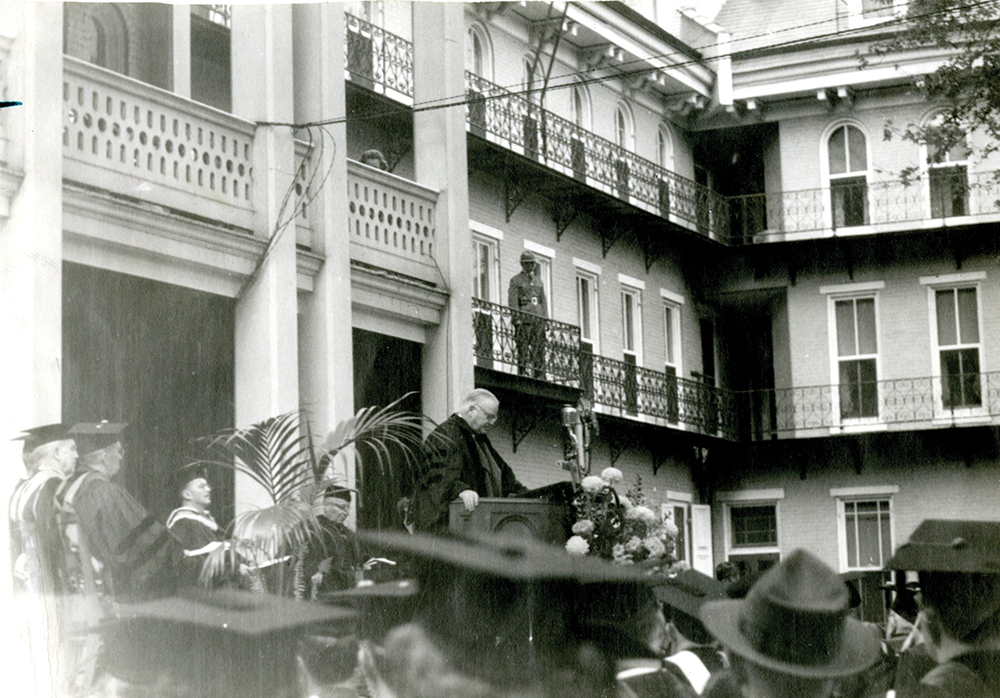
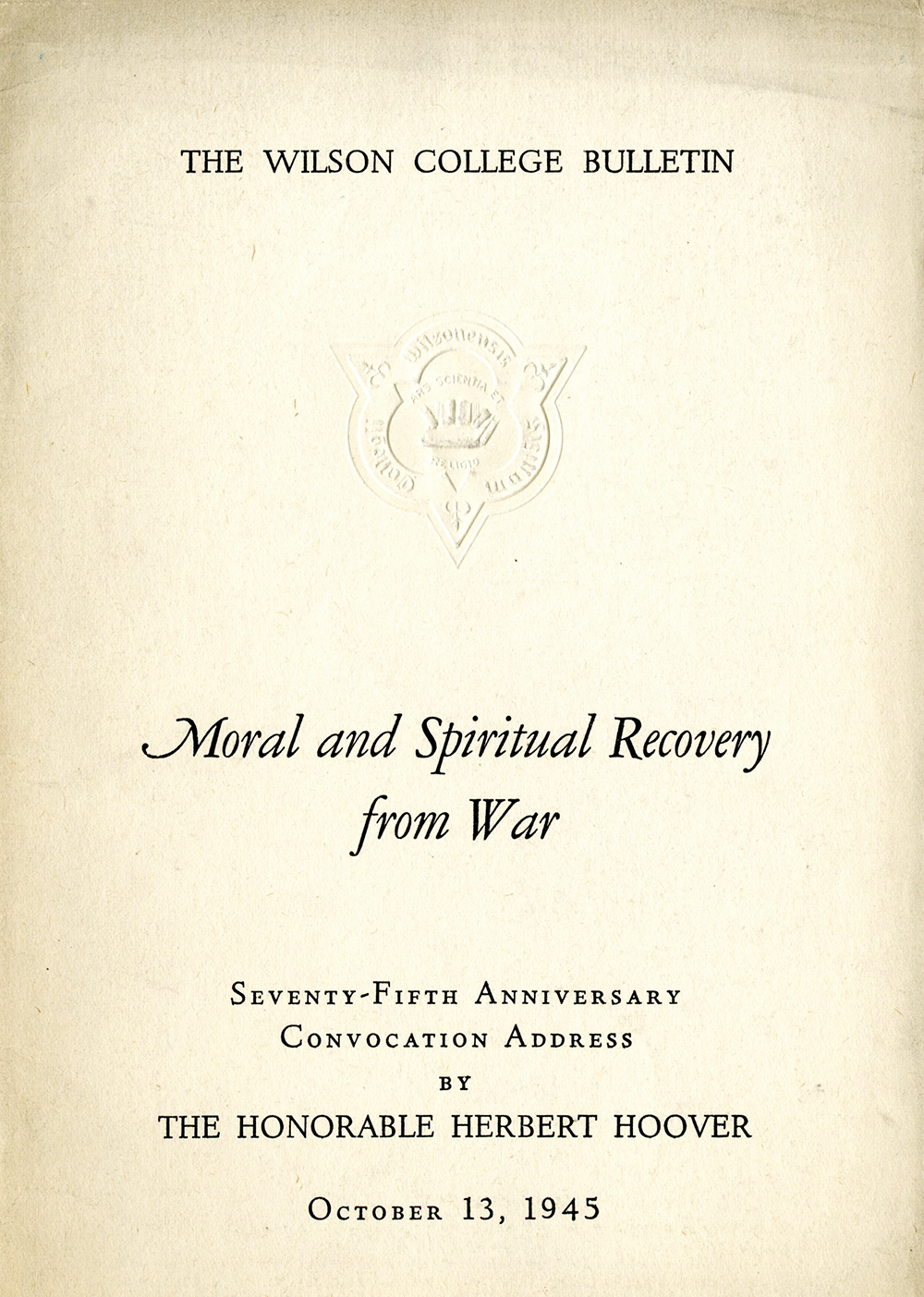
It was an epic event on Oct. 13. The Wilson Alumnae Quarterly stated that Hoover received “a royal welcome” from both the institution and the town.(7) People poured into Chambersburg. At the convocation, the governor of Pennsylvania, Edward Martin, introduced Hoover. Martin referred to Hoover as “our great Elder Statesman” and “our greatest living American.”(8) Hoover’s speech, “Moral and Spiritual Recovery from War,” highlighted the war’s impact and the need for leadership in the aftermath of the conflict. Hoover stated, “One of the riches of American life is the vast reservoir of leadership in the people. But leaders are not found like queen bees.” Hoover envisioned the U.S. education system as a conduit for the next generation of leaders. “No doubt there are men and women who rise to leadership without the full help of our colleges. But our national supply would be poor indeed if we had to depend upon this method,” claimed Hoover.(9) Moreover, for Hoover, leadership needed to be represented by all citizens. “We must have leadership in every branch of life from the shop foreman to the President,” stressed Hoover.(10) This all encompassing notion of leadership was essential for the nation to persevere.

World War II took the lives of millions of people around the globe; the United States was not insulated from the carnage—hundreds of thousands of Americans perished. Hoover recognized the toll that war took on the nation’s future. Hoover asserted, “In our lists of dead are a multitude who would have given intellectual leadership to our people.”(11) With that loss, the urge for renewal was important. Hoover emphasized that “colleges have a great obligation courageously to restore our moral and spiritual losses from the war, to renew our ideals of freedom, to regain our sensitiveness to wrong, and to provide the nation with renewed supply of trained leadership.”(12) Hoover aimed for college students, such as those attending Wilson College, to gain knowledge to lead the United States in a postwar era.

Wilson community members were very engaged in preparing for and during the celebration. Students had signed their names on a scroll as a token for Hoover. Hoover expressed his gratitude, writing that the scroll served “as a constant reminder of a fine occasion and a wonderful group of students.”(13) Similarly, in a letter to Havens, Hoover stated, “I cannot refrain from telling you how fine an occasion last Saturday was and how much I appreciate the many courtesies extended to me by you, the college and the community.”(14) During the three-day jubilee, connections to Wilson’s long history shined. Flora Witherspoon, Wilson College’s eldest living alumna, participated. Witherspoon informed the press that she had “always admired” Hoover.(15) Additionally, Wilson College founder James W. Wightman’s daughters came to celebrate the milestone.(16)
Hoover’s speech received praise. In a letter to Hoover, Havens remarked, “From all sides have come enthusiastic comments upon your address. In every respect it was timely, thoughtful, and statesmanlike. You have pointed out to all of us, and to every educational institution, the responsibility which is ours and which we shall not seek to evade.” Letters poured in asking for copies of Hoover’s speech.(17) Newspapers throughout the country quoted from his speech. Moreover, gratitude for Hoover’s visit, along with his words,
extended beyond President Havens. Lorraine Havens, wife of President Havens, wrote to Hoover. “It was an occasion that none of us can ever forget,” she claimed while lauding Hoover for his “splendid speech.”(18) Eve Garrette also conveyed her appreciation for Hoover’s participation, stating “that the unanimous opinion is that your speech was possibly the greatest you have ever made.”(19) Even though Hoover was no longer the U.S. president, Hoover’s words still carried tremendous weight.

Herbert Hoover inspired Wilson students, their families, and the Chambersburg community in 1945. Decades later, Hoover’s emphasis on colleges shaping the next generation of leaders is as important as it was in 1945. Although Wilson College has evolved from the type of institution it was in 1945, critical threads remain the same. Wilson College has molded, and continues to mold, students into leaders, living up to the words espoused by the 31st president of the United States.


Special thanks to the staff at the Herbert Hoover Presidential Library, along with Elizabeth McIlhenney, Wilson College archivist, and Jeremiah Loyer ’27 for their assistance with this article.


1 Paul Swain Havens to Herbert Hoover, July 12, 1945, Post-Presidential Papers, Subject Files, Colleges and Universities, Wilson College, Herbert Hoover Presidential Library.

2 Herbert Hoover to Paul Swain Havens, July 17, 1945, Post-Presidential Papers, Subject Files, Colleges and Universities, Wilson College, Herbert Hoover Presidential Library.

3 Herbert Hoover to Paul Swain Havens, August 1, 1945, Post-Presidential Papers, Subject Files, Colleges and Universities, Wilson College, Herbert Hoover Presidential Library.

4 Eve Garrette to Herbert Hoover, July 16, 1945, Post-Presidential Papers, Individual Correspondence, Eve Garrette, Herbert Hoover Presidential Library.

5 “CBS Hook-Up to Carry Hoover Address Here,” Wilson Billboard, October 13, 1945, 2.

6 Helen Delich, “Wilson College Begins 3-Day Diamond Jubilee Celebration,” Baltimore Sun, October 13, 1945, 7.

7 “Community Paid Tribute to Former President,” Wilson Alumnae Quarterly (November 1945): 8. Publications (WA-16). C. Elizabeth Boyd ’33 Archives, Wilson College.

8 “Address of Major General Edward Martin, Governor of Pennsylvania, Introducing the Honorable Herbert Hoover,” Wilson Alumnae Quarterly (November 1945): 4.

9 Herbert Hoover, “Moral and Spiritual Recovery from War,” in Wilson Alumnae Quarterly (November 1945): 6.

10 Hoover, “Moral and Spiritual Recovery from War,” 5-6.

11 Hoover, “Moral and Spiritual Recovery from War,” 5.

12 Hoover, “Moral and Spiritual Recovery from War,” 6.

13 “Hoover Lauds 75th Birthday Fete,” Public Opinion, October 18, 1945, 1.

14 Herbert Hoover to Paul Swain Havens, October 15, 1945, Post-Presidential Papers, Subject Files, Colleges and Universities, Wilson College, Herbert Hoover Presidential Library.

15 “Oldest Wilson Alumna Objects to Modern Attire,” Lancaster New Era, October 12, 1945, 8.

16 Delich, “Wilson College Begins 3-Day Diamond Jubilee Celebration,” 7.

17 Paul Swain Havens to Herbert Hoover, October 16, 1945, Post-Presidential Papers, Subject Files, Colleges and Universities, Wilson College, Herbert Hoover Presidential Library.

18 Lorraine Havens to Herbert Hoover, October 16, 1945, Post-Presidential Papers, Subject Files, Colleges and Universities, Wilson College, Herbert Hoover Presidential Library.

19 Eve Garrette to Herbert Hoover, October 15, 1945, Post-Presidential Papers, Individual Correspondence, Eve Garrette, Herbert Hoover Presidential Library.

RELATED: The Balkans and Beyond: A Journey of History, Adventure, and Great Food Students Between the Tides Wilson’s Strategic Partnership Fuels Innovation

Wilson’s Strategic Partnership Fuels Innovation

by Else Drooff Valenzuela, Enrollment Consultant with Rize

Since 2020, Wilson College has partnered with Rize Education to strategically add degree programs in Computer Science, Cybersecurity, and Supply Chain Management, and concentrations in Integrative Neuroscience, Graphic Design, and Web Design. This marks a new growth model—one that leverages a nationwide consortium of independent colleges to share specialized curricula and faculty expertise.

“What intrigued me was the opportunity to enhance what we’re doing in ways we wouldn’t be able to do on our own,” said Michael Cornelius, Ph.D., dean of The School of Arts and Sciences, while reflecting on Wilson’s partnership with Rize Education. Initially skeptical, Cornelius now oversees four Rize-powered programs and calls them “the perfect complement to what we’re doing at Wilson.”

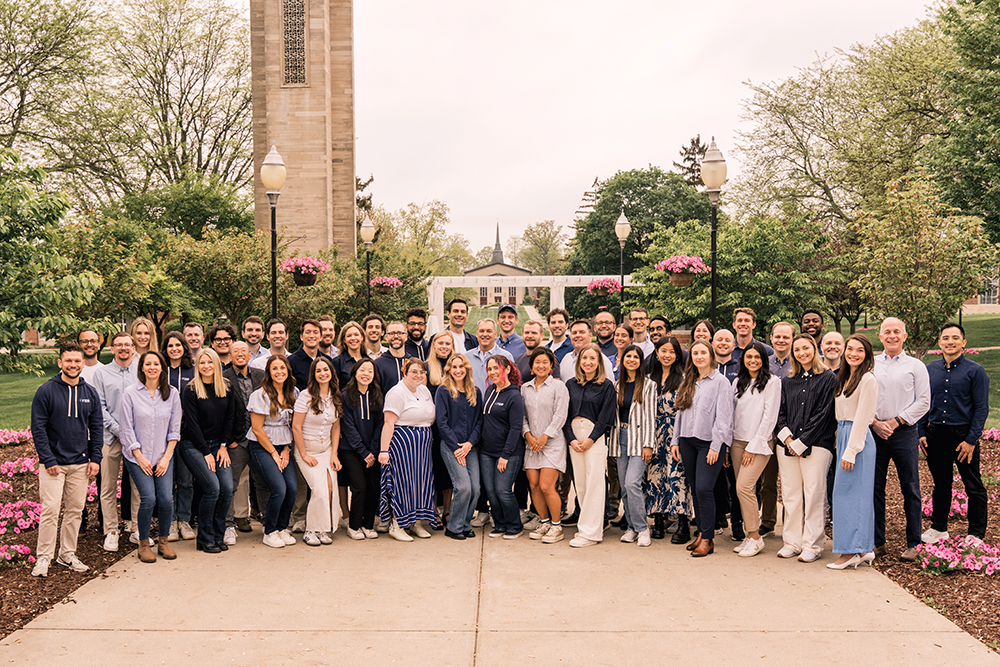
The Rize Team

About Rize Education

Rize was founded in 2019 after cofounders Kevin Harrington and Connor McCarthy spent two years living on the campus of Adrian College in Michigan, working alongside President Jeffrey Docking to understand what small colleges need to thrive without compromising identity. The result was a collaborative model that preserved Adrian’s distinctive culture while adding 27 programs that attracted new students. The model has since resonated with more than 135 small colleges nationwide, institutions looking to meet student demand for career-focused programs while maintaining the personalized, value-centered education that defines colleges like Wilson. Rather than replacing what small colleges do well, the consortium model adds capacity in fields where institutions often struggle to hire and retain specialized faculty.

The Consortium Model

Wilson is a member of the Lower Cost Model Consortium (LCMC), a collective of higher education institutions with the common goal of providing top-quality, lower-cost education. By partnering with Rize and joining the LCMC, Wilson gains access to expertise in rapidly evolving fields where specialized hiring can be particularly challenging for small colleges.

Rize develops rigorous, career-aligned courses with consortium member institutions and industry experts.  Through a hybrid structure, students take specialized courses online through the consortium, taught by faculty from other colleges, while most of their coursework remains in-person with Wilson professors. A Cybersecurity major, for example, completes technical core courses through Rize while still taking business, liberal arts, and elective courses with Wilson faculty.

“What appealed to me most was the opportunity for students to learn from a range of instructors across the Consortium,” says Philip Lindsey, M.A., M.F.A., professor of fine arts, who oversees the Web Design program.

Joshua Legg, M.F.A., dean of The School of Professional and Graduate Studies, views the partnership from an interdisciplinary perspective shaped by his career in the arts. The partnership, he says, allows Wilson to offer technical expertise “while maintaining the interdisciplinary, liberal arts approach that makes Wilson distinctive.” Students gain “both the technical skills and the creative thinking employers actually need.”

Attracting New Student Populations

The partnership is shaping who chooses Wilson. Heather Lemaster, a 29-year-old transfer student from Harrisburg Area Community College (HACC), had three criteria when applying to bachelor’s degree programs: a 50-minute commute, affordability, and a strong Cybersecurity program. Wilson came recommended by family, but it was the new Cybersecurity major that sealed her decision. The flexibility of online coursework was “a giant bonus for a non-traditional student like me,” she says.

Michael Rios, another HACC transfer, chose Wilson specifically for graphic design. Though another college was closer to home, “they didn’t have a graphic design program, so I chose Wilson.” In the User Experience I course through Rize, he appreciates the structure: “It’s easy to work ahead and plan out your days.” He has already gained immediately marketable skills, including user interview techniques, empathy mapping, and working with the design platform Figma. The course, he says, offers “highly transferable skills” and “a distinct thought process that’s been really helpful to learn.”

These students represent net-new enrollment, meaning students are choosing Wilson because of the programs the College can now offer through Rize. Moreover, their sentiments mirror broader outcomes: Wilson’s Rize courses have a 96% pass rate and 88% of students say they would recommend them to others.

Strategic Resource Allocation

The partnership helps Wilson expand offerings while staying true to its strengths. As Dean Cornelius notes, it allows the College to add programs in high-demand fields, such as artificial intelligence, without diverting focus from the liberal arts foundation that grounds Wilson’s academic identity.

Computer Science is a prime example: it draws expertise from professionals at Google, Meta, Amazon, Microsoft, and Capital One, alongside academics from Harvard and the University of Pennsylvania, complementing the work of Wilson’s faculty. Tom Sarachan, M.F.A., J.D., assistant professor of computer science, has been very pleased with the structure. With students taking classes both on campus and through Rize, the hybrid model allows him to focus on building the on-campus community while students access advanced, specialized courses through the Consortium.

Real Career Outcomes

Wilson’s Rize-powered programs align with strong growth fields in Pennsylvania. According to labor market analytics firm Lightcast, Computer Science grew 10.5% between 2023-2024, Cybersecurity 8.7%, Web Design 7.2%, and Supply Chain Management 6.5%. Nationally, software developers earn median salaries above $130,000; logisticians earn $76,270; and cybersecurity roles remain critically understaffed, with roughly 663,000 unfilled positions and median wages around $103,000.

In creative fields, web developers earn around $80,730. Lindsey notes that graphic design graduates fare exceptionally well: “Our graduates often secure positions very quickly—many even before they finish their degree.”


How You Can Help

As Wilson students gain expertise in these fields, they need real-world experience to deepen their learning. Alumnae and alumni working in these industries can play a vital role.

Are you interested in hosting a Wilson intern in any of these programs? Whether you work in technology, logistics, design, or cybersecurity, your involvement can help launch a student’s career.

To learn more about internship sponsorship opportunities, please contact the Wilson College Career Development Center at career@wilson.edu. Your support directly strengthens the next generation of
Wilson graduates.

RELATED: The Balkans and Beyond: A Journey of History, Adventure, and Great Food Students Between the Tides When Herbert Hoover Visited Wilson College

Igniting the Future: The Phoenix Soars 2025-2028

Over the years, Wilson College has stood as a beacon of education and transformation. Today, there is a growing buzz on campus and beyond as more people recognize the power of this institution to not only educate, but to change lives like never before.

“When I’m in the community, I feel a real sense of enthusiasm and momentum around Wilson. The positive attention we’re receiving reflects the fact that while we’re not fully thriving yet, we are clearly on that path—honoring 157 years of history while transforming more students’ lives than ever before,” said
President Wesley R. Fugate, Ph.D.

The next chapter of Wilson’s story builds on the momentum of the previous strategic plan, Future Wilson: The Phoenix Rises, which ended this past June. Now, it is time for a new roadmap, one shaped by a true community effort. Faculty, staff, students, alumnae, alumni, and Trustees all contributed their voices and ideas. Together, they asked: How can Wilson best serve today’s students, and tomorrow’s Phoenix? The answers shaped a vision that keeps the student experience at its core, and the result is a bold new plan that charts a course through the challenges that lie ahead: Igniting the Future: The Phoenix Soars, which will guide Wilson through the 2025-2028 academic years.

At Wilson, we’ve embraced big dreams and made tough decisions to position our alma mater for success, but the vision and values of the College remain the same. With the strategic imperatives of Igniting the Future, the focus will be on the enrollment and retention of students, facilities and deferred maintenance, faculty and staff retention, career preparation and employment outcomes of our students, and, of course, strengthening the institution’s financial position. These key performance indicators will guide the College as it moves forward with new strategic initiatives.

Through the implementation of this plan, Wilson will remain focused on her mission to prepare graduates who are confident thinkers, creative visionaries, effective communicators, honorable leaders, and agents of justice. For more than 157 years, this commitment has guided the institution’s work. With a solid foundation now established, Igniting the Future provides a clear framework to sustain that mission and advance Wilson’s continued strength and distinction.

VISION
Creating possibilities.
Forging exceptional student success.
Transforming lives.

MISSION
Wilson College empowers students to be confident and critical thinkers, creative visionaries, effective
communicators, honorable leaders, and agents of justice.

STRATEGIC IMPERATIVES

I. Deliver Impactful Student Experiences Through Purposeful Programs

DEFINITION: Integrate proven, evidence-based strategies across academic and co-curricular pathways that enhance student engagement and learning.

GOAL 1: High Impact Practices drive greater student engagement in academic pursuits and campus life, leading to a greater sense of belonging and community.

GOAL 2: Graduate employment outcomes are bolstered by enhanced career exploration and preparation experiences.

II. Illuminate Our Story

DEFINITION: Deepen understanding and pride in the Wilson College brand with all constituents, including local and regional communities.

GOAL 1: Wilson College is known regionally as an affordable, accessible private institution of choice providing undergraduate, graduate, and doctoral degrees via online, in-person, and hybrid modalities.

GOAL 2: The greater Chambersburg community as well as alumni, current students, faculty, and staff identify and understand the College’s brand story and can speak about it with pride and confidence.

III. Foster A Data-Informed Campus Culture

DEFINITION: Leverage technology to streamline administrative processes to better meet institutional goals and deliver a seamless student experience.

GOAL 1: A college-wide data management strategy improves data retention and decision-making.

GOAL 2: Student experience obstacles are eliminated with the use of technology that improves staff/faculty processes and productivity.

IV. Rejuvenate And Inspire Our Workforce

DEFINITION: Support students by reinvigorating faculty and staff in their work to deliver the Wilson educational experience.

GOAL 1: A shared understanding of workforce needs leads to formal and informal initiatives that improve overall job satisfaction.

GOAL 2: Improved retention of faculty and staff enhances the student experience at all levels.

V. Strengthen The Institution’s Financial Position

DEFINITION: Diversify and grow revenue streams while managing institutional expenses through innovative, mission-centric strategies that support long-term sustainability.

GOAL 1: Pursue new revenue generating opportunities and cost containment strategies that align with the College’s Vision, Mission, and Values.

GOAL 2: Steward and increase donor engagement and philanthropic support of the College and her future goals.

RELATED: The Balkans and Beyond: A Journey of History, Adventure, and Great Food Students Between the Tides When Herbert Hoover Visited Wilson College